
🏗️ Heavy Lift Crews in Action: How They Manage Oversized Maritime Cargo
- Davide Ramponi

- 31. Dez. 2025
- 5 Min. Lesezeit
My name is Davide Ramponi, I’m 21 years old and currently training as a shipping agent in Hamburg. On my blog, I take you with me on my journey into the exciting world of shipping. I share my knowledge, my experiences, and my progress on the way to becoming an expert in the field of Sale and Purchase – the trade with ships.
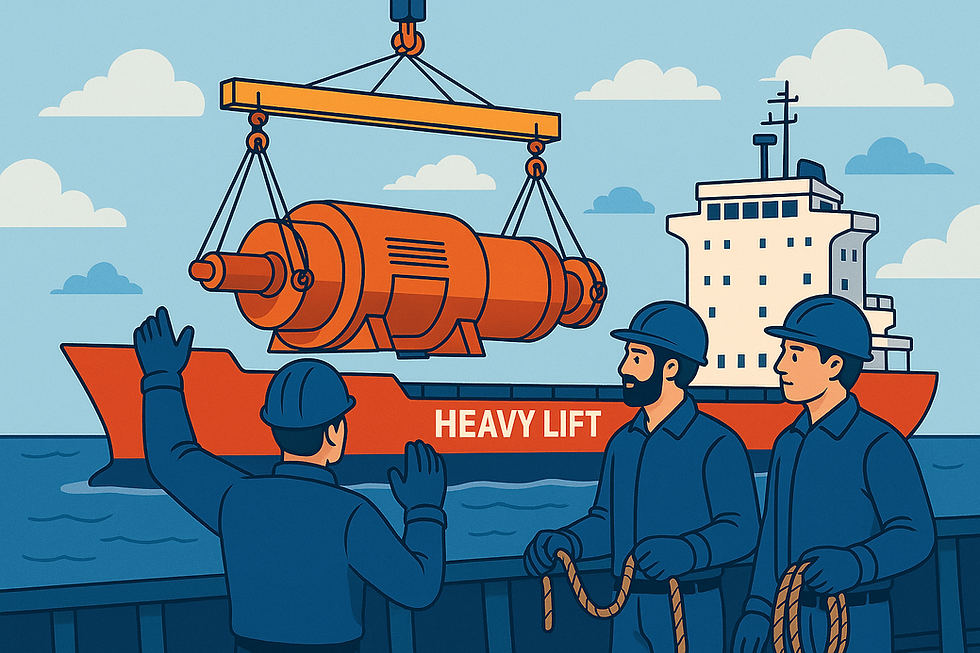
When most people imagine cargo ships, they think of rows of neatly stacked containers or bulk loads of grain and coal. But in the world of heavy lift shipping, the job is anything but typical.
From wind turbine blades to entire locomotives, and even prefabricated industrial plants, heavy lift crews move cargo that doesn’t fit in a box — and barely fits on a ship. It’s a world where planning is an engineering science, loading is choreography, and every operation is a performance of logistics brilliance.
🔍 In this post, I’ll walk you through:
📐 The planning, engineering, and calculation behind each lift
🔩 How crews load and secure out-of-gauge cargo
⚙️ The ships and tools built for these oversized jobs
⚠️ Safety, balance, and what can go wrong
🚢 Iconic heavy lift projects and what makes them so legendary
Let’s lift the curtain (and some serious steel) on this fascinating niche of shipping.
📊 Engineering First: The Art of Pre-Lift Planning
Before any crane moves an inch, the heavy lift team has already spent weeks, if not months, in planning.
It all starts with one question: Can we even lift it safely?
🚧 Planning includes:
Weight verification and center of gravity mapping
Stress analysis on deck structures
Load spreading plans and cradle design
Route simulations (road-to-port-to-ship transfers)
Permits for special cargo (especially for military or nuclear items)
Most heavy lift vessels carry specialized engineers and naval architects onboard or work with external consultants to model the lifting and sea transport process in 3D — including stability impact, sea fastenings, and dynamic behavior during swell.
📐 Example:
Moving a 500-ton generator requires not only crane strength but precise deck reinforcement calculations. If weight concentration is too high, the ship’s own structure could suffer damage.
🪝 The Lift: Loading and Securing the Unusual
When it’s time for action, every step of the lift is timed, coordinated, and rehearsed.
🔧 Loading steps often include:
Positioning mobile cranes, gantry systems, or shipboard cranes
Rigging slings, spreader bars, and shackles — tailored to each item
Slow, steady lifting, constantly monitored for sway or twist
Placement and alignment on pre-fabricated cradles or dunnage
Securing with lashings, welding, or sea fastenings to withstand rolling seas
These aren’t standard ratchet straps. Think massive chain lashings, welded stoppers, hydraulic clamps, and braced custom frames designed for dynamic G-forces at sea.
📦 Fun fact:
Some cargo like transformers or wind blades are so delicate that maximum tilt angles must be kept under 10° during the lift.
And what if the item arrives without proper lifting points or design flaws? That’s where modifications, adapters, or re-rigging improvisation comes in. Creativity is essential in heavy lift operations.
⚙️ Specialized Ships and Equipment: When Standard Isn’t Enough
Heavy lift operations demand a whole fleet of purpose-built vessels and gear.
🛳️ Common heavy lift ship types:
Semi-submersible vessels (like the Dockwise Vanguard) that flood and sink part of their deck for floating loads
Project cargo ships with twin cranes (up to 2,000+ tons combined capacity)
Deck carriers or float-on/float-off barges
Heavy gear RoRos (for rolling massive units aboard)
⚙️ Specialized tools include:
Self-propelled modular transporters (SPMTs) for rolling cargo from quay to deck
Hydraulic lifting gantries for onshore operations
Ballasting systems to maintain trim during asymmetric loads
Load monitoring software and motion sensors for dynamic tracking
🧰 Example:
To transport a 1,300-ton chemical reactor, one project team used a semi-submersible vessel, twin cranes with synchronized lift software, and a 64-axle SPMT system. The journey was monitored by a live digital twin model.
⚠️ Safety and Stability: The Hard Part No One Sees
With heavy lift cargo, safety isn’t just about protecting people — it’s about preserving the ship’s entire balance.
Unbalanced loads or poor lashing can result in:
Loss of cargo overboard 🌊
Severe ship listing ⚓
Internal structural failure or cracking
Crew injury during rough seas
📐 Stability is calculated in both static and dynamic conditions:
Static: while loading/unloading at port
Dynamic: during the voyage, accounting for waves, swell, and rolling
That’s why every lift plan includes emergency stop procedures, ballast adjustment protocols, and continuous monitoring of lashings and deck deflection during the voyage.
💬 “The cargo doesn’t move at sea… until it does,” one heavy lift captain told me. “And by then, it’s too late. That’s why we over-secure everything.”
🚢 Iconic Heavy Lift Projects: When Shipping Becomes Spectacle
Some lifts go beyond impressive — they make headlines. Let’s look at a few iconic projects:
🏗️ Floating a Floating Drydock
In 2013, the Dockwise Vanguard carried a massive floating drydock from China to Brazil. It was over 90,000 tons — effectively a ship carrying another shipyard. The vessel submerged itself, let the dock float above, and then re-surfaced under the load.
🚆 Locomotive Transport to Africa
A heavy lift ship transported 27 brand-new locomotives from Spain to Nigeria. The vessels had to be secured with individual wheel locks, steel chocks, and custom cradles, each engineered for the vibration profile of the crossing.
🏗️ Oil Platform Module Moves
Large platforms are often built in pieces and transported to sea via deck carriers. Some modules weigh over 10,000 tons and are installed using float-off operations, crane barges, and GPS-aligned positioning.
These are more than jobs — they’re logistical art, blending engineering, naval architecture, and human precision.
🌍 Global Network, Local Precision
Heavy lift logistics are global by design. Often, the manufacturing site, port of origin, and final destination are on different continents — each with its own regulations, infrastructure, and weather patterns.
🧭 Logistics teams must:
Coordinate inland transport (rail, road permits, civil engineering adjustments)
Arrange port handling cranes and berth strength checks
Time tidal windows for loading at shallow ports
Secure customs approvals for specialized or restricted cargo
📌 In some cases, the heaviest challenge isn’t at sea — it’s getting the item from the factory to the port, involving road closures, power line removals, and civil escorts.
🤝 Teamwork at Every Turn
A heavy lift operation brings together a multi-disciplinary team:
👷 Project cargo specialists
🛠️ Engineers and naval architects
⚓ Port agents and stevedores
🚧 Crane operators and riggers
📋 Surveyors and insurers
One missed measurement or miscommunication can delay a project by weeks or cost millions.
✅ That’s why pre-load meetings, risk assessments, and clear hierarchy are vital. Every move is choreographed and double-checked.
And yes — the crew on the vessel are trained to understand heavy lift procedures, crane systems, emergency actions, and securement checks, because they live with the cargo for days or weeks.
📌 Conclusion: Big Lifts, Bigger Responsibility
In the world of heavy lift shipping, every ton counts — and every centimeter matters. It’s not just a job of cranes and chains, but of planning, precision, and pride.
Key Takeaways 🎯
📐 Planning and engineering are the foundation of every lift🪝 Loading requires specialized tools, timing, and training
🚢 Ships are purpose-built — from submersibles to twin-crane carriers
⚠️ Safety is paramount, from stability checks to sea fastening
🌍 Heavy lift projects show what’s possible in global logistics
Next time you see a wind turbine at sea or a refinery module in the middle of the desert — think of the heavy lift crew that got it there.
👇 Have you seen or worked on a heavy lift project?
💬 Share your thoughts in the comments — I look forward to the exchange!




Kommentare