
🛡️ A Day in the Life of a Ship Security Officer: Duties, Drills, and Defenses
- Davide Ramponi

- 30. Dez. 2025
- 5 Min. Lesezeit
My name is Davide Ramponi, I’m 21 years old and currently training as a shipping agent in Hamburg. On my blog, I take you with me on my journey into the exciting world of shipping. I share my knowledge, my experiences, and my progress on the way to becoming an expert in the field of Sale and Purchase – the trade with ships.
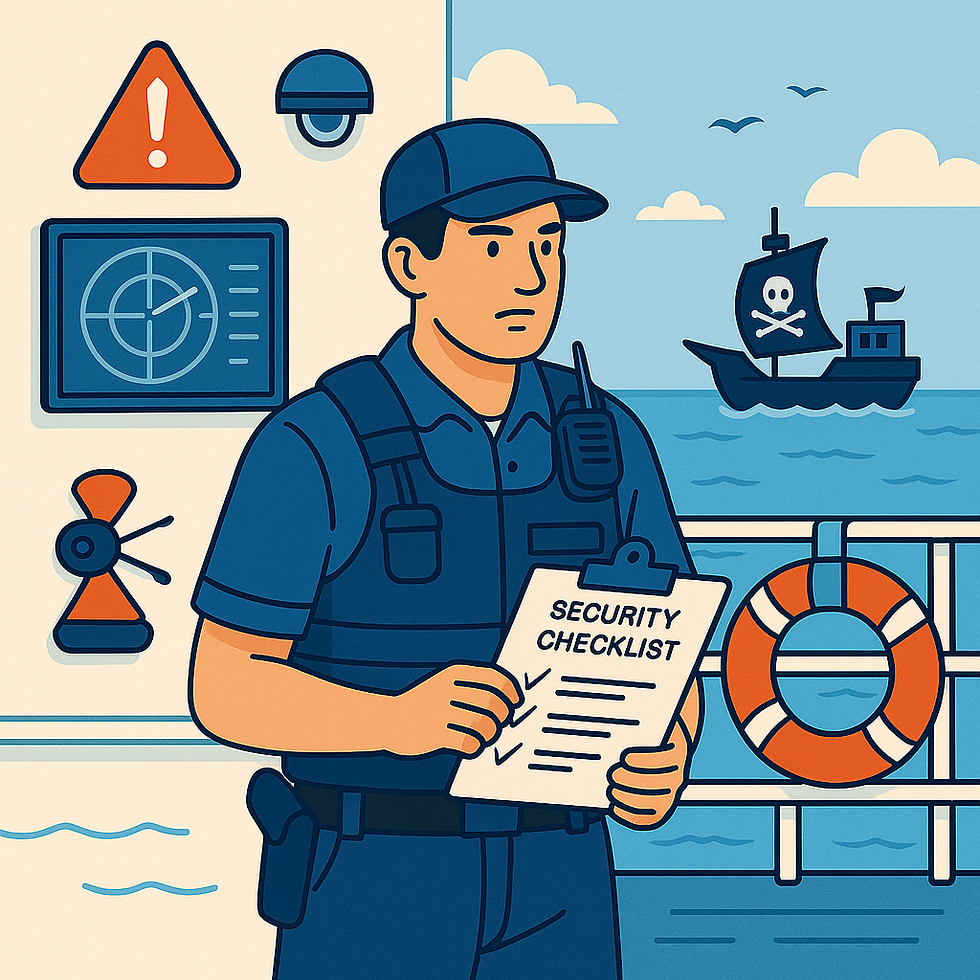
When we think of shipping, we often imagine navigation, logistics, or engineering. But in a world of rising piracy, terrorism, smuggling, and stowaway risks, maritime security has become a central pillar of vessel operations. And at the frontline of it all? The Ship Security Officer (SSO).
They’re not wielding rifles or wearing uniforms with medals—but make no mistake: their role is as strategic and mission-critical as the captain’s. From drills and patrols to international compliance and stowaway detection, the SSO’s daily life is a complex blend of vigilance, coordination, and responsibility.
🔍 In this post, I’ll walk you through:
🔐 Core duties under the ISPS Code
🚶♂️ Daily routines: patrols, monitoring, and emergency drills
🚨 Responding to piracy and stowaways
🌐 Cooperation with port state and national authorities
📡 Tools and technologies used in shipboard security
Let’s step into the shoes of a Ship Security Officer—and follow them across a typical day at sea.
⚖️ What Is the ISPS Code—and Why Does It Matter?
Before diving into a day in the life, we need to understand the legal framework behind maritime security: the ISPS Code.
🔍 ISPS stands for International Ship and Port Facility Security Code. It was implemented after 9/11 as part of SOLAS (Safety of Life at Sea) regulations to establish a global maritime security system.
Under the ISPS Code, every ship must have:
A Ship Security Plan (SSP)
A designated Ship Security Officer (SSO)
A clear security alert system (SSAS)
A process for security assessments, drills, and record-keeping
The SSO is the person responsible for implementing, maintaining, and adapting the security plan. It’s not just paperwork—it’s about lives, compliance, and cargo worth millions.
🌅 Morning Briefing: Security Starts with Awareness
A typical SSO’s day begins early—with a security status check. While the crew might be focused on navigation or maintenance, the SSO is already cross-checking threat alerts and updating the security level based on region and current conditions.
🗒️ Their routine checklist might include:
Reviewing the SSP and Ship Security Logbook
Checking messages from Company Security Officer (CSO) or port states
Verifying the integrity of watertight and secure areas
Confirming that restricted zones are locked and monitored
Running morning muster with deck watch crew
📡 If the ship is approaching a high-risk area like the Gulf of Aden or the Strait of Malacca, the SSO increases Security Level 2 or 3—activating additional protocols.
🚶♂️ Patrols and Surveillance: Walking the Line
One of the most visible parts of the SSO’s day is physical patrol. Security officers don’t just sit behind screens—they walk the decks, check access points, talk to crew, and ensure every part of the vessel is as it should be.
🕵️♂️ A standard patrol includes:
Inspecting fencing, gangways, and deck perimeters
Ensuring cargo hatches and ballast tanks are sealed
Checking lifeboats and emergency escape routes
Monitoring CCTV feeds from blind zones
Verifying ID badges and logbooks for contractors or visitors
🔍 Red flags might include:
Tampered locks
Unauthorized persons on deck
Floating objects nearby (potential piracy tools or markers)
Loose mooring lines or signs of forced entry
Many SSOs carry handheld radios, flashlights, multi-tools—and increasingly, mobile tablets linked to the ship’s central monitoring system.
🚨 Drills, Response, and Real-World Scenarios
Security is not about reacting—it’s about being prepared before anything goes wrong. That’s why the SSO organizes and leads mandatory security drills.
🧯 Typical security drills include:
Stowaway search simulation
Ship Security Alert System (SSAS) activation
Piracy response: lockdown, crew mustering, evasive maneuvers
Suspicious object handling (e.g., checking for explosives or contraband)
🕵️ Dealing with Stowaways and Piracy
Some of the most challenging moments for any SSO come when drills turn into reality.
👤 Stowaways
These are unauthorized individuals who secretly board a vessel—usually in port—often seeking asylum or escape.
The SSO is responsible for:
Detection (during patrols or inspections)
Ensuring humane treatment and safety of the individual
Informing port and flag state authorities
Coordinating with the shipowner and P&I club
Preparing detailed incident reports
📌 Fun fact:
According to IMO, most stowaways are discovered only after a vessel departs—making proactive inspections essential.
🏴☠️ Piracy
Though less frequent today, piracy remains a threat in several regions. The SSO’s duties include:
Implementing Best Management Practices (BMP5)
Installing razor wire, water cannons, and fake guards
Organizing safe muster points (citadels) for crew
Monitoring AIS, radar anomalies, and suspicious vessels
💡 Many SSOs train in non-lethal defense techniques, ensuring the crew is protected without escalation.
🛂 Working with Ports and Authorities
The SSO is also the liaison between the ship and external agencies—particularly during port calls or emergencies.
📞 Their coordination duties involve:
Filing security declarations with port facilities
Liaising with Port Facility Security Officers (PFSOs)
Assisting in customs inspections
Ensuring compliance with immigration and quarantine protocols
In high-risk areas, the SSO may even interact with naval escorts, coast guards, or private maritime security teams.
🧑✈️ A common quote:
“The SSO is the ship’s shield—not just against external threats, but legal risk too. They keep you compliant and protected.”
⚙️ Tools and Tech: Security in the Digital Age
Maritime security today is no longer just a matter of chains and checklists. Ship Security Officers use a growing toolkit of smart technologies.
📡 Common tools include:
CCTV systems with motion detection and night vision
SSAS (Ship Security Alert System) with silent alarm capability
Electronic access control and biometric scanners
Mobile patrol reporting apps for real-time logging
Drones or pole cameras for hard-to-reach inspection zones
Emerging innovations:
AI-assisted anomaly detection in engine and hull areas
Blockchain tracking for secure cargo documentation
Cybersecurity monitoring, often overseen by the SSO in collaboration with IT
🔐 As threats evolve, so does the job—security today is as much about information warfare as physical defense.
🧾 Logging and Documentation: The Paper Trail That Protects
No SSO’s day is complete without detailed recordkeeping.
🗂️ They document:
Patrol times and findings
Visitor logs and ID scans
Security drill outcomes
Communications with authorities
Any security breaches or irregularities
Why does it matter? Because during port inspections or legal inquiries, documentation can make or break your compliance standing.
A well-maintained logbook is a security officer’s second shield—paper proof that everything was done by the book.
🔚 Wrapping Up: Vigilance Without Spotlight
By the time the rest of the crew winds down, the Ship Security Officer is still reviewing logs, checking locks, and preparing the next day’s risk briefing.
Their work is often unseen but always essential—like a lighthouse that doesn’t move, but keeps everyone else safe.
📌 Conclusion: Security Isn’t Just a Role—It’s a Mindset
The role of a Ship Security Officer combines legal responsibility, situational awareness, crisis management, and human judgment. It's a job of many hats, few breaks, and constant focus.
Key Takeaways 🎯
🛡️ The SSO enforces the ISPS Code and leads shipboard security
👣 Daily duties include patrols, drills, and compliance
🚨 They respond to piracy, stowaways, and suspicious behavior
🌐 Coordination with authorities is vital at every port
📡 Technology is enhancing the efficiency and reach of security tasks
Next time you see a ship, think beyond cargo or crew—think about the silent sentry keeping it secure.
👇 Have you worked with or as a Ship Security Officer? What challenges did you face?
💬 Share your thoughts in the comments — I look forward to the exchange!


Kommentare