
⚡ Alternative Marine Fuels: Navigating the Compliance Maze of LNG, Methanol & Hydrogen
- Davide Ramponi

- 2. Juli 2025
- 5 Min. Lesezeit
My name is Davide Ramponi, I am 20 years old and currently training as a shipping agent in Hamburg. In my blog, I take you with me on my journey into the exciting world of shipping. I share my knowledge, my experiences, and my progress on the way to becoming an expert in the field of Sale and Purchase – the trade with ships.
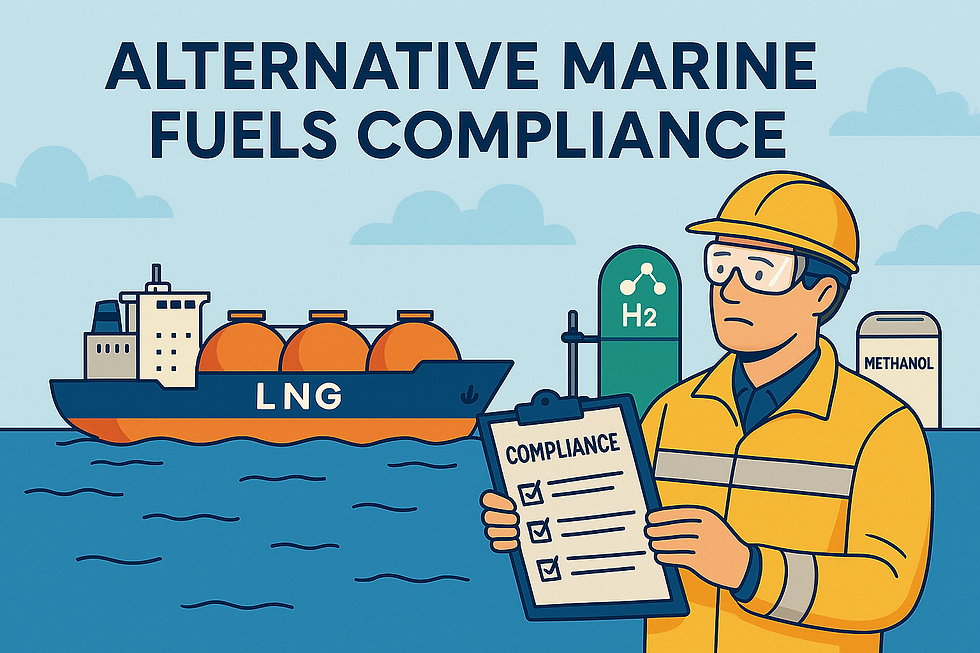
The shipping industry is undergoing one of its biggest transitions since the move from sail to steam: the shift to alternative fuels. Whether you're looking at LNG, methanol, or the promising frontier of hydrogen, the motivation is clear—lower emissions, higher efficiency, and future-proof compliance.
But there’s one thing that stands in the way of smooth adoption: regulation.
How do you ensure a vessel running on methanol meets IMO and flag-state requirements? What about port safety protocols for hydrogen bunkering? And what happens when rules change faster than fleets can adapt?
In this post, I’ll unpack the compliance landscape for alternative fuels, break down certification requirements, flag key safety standards, and explore what shipowners, operators, and ports need to prepare for—today and tomorrow.
Let’s dive into the future. ⚓🌱
🌍 Why Compliance Matters for Alternative Fuels
Switching to an alternative fuel isn’t just about technology or cost—it’s about meeting international regulatory expectations.
Whether under MARPOL, SOLAS, or IMO’s upcoming carbon intensity rules, compliance ensures:
Safe operations
Port access and bunkering permissions
Flag state approval
Legal protection in the event of incidents
🚢 In short: If your ship burns cleaner but can’t prove it’s compliant, you won’t go far.
🔒 Safety & Environmental Standards: LNG, Methanol & Hydrogen
Each fuel comes with unique risks—and regulators are watching closely.
1. LNG (Liquefied Natural Gas)
✅ Standards and codes:
IMO’s IGF Code (International Code of Safety for Ships using Gases or other Low-Flashpoint Fuels)
MARPOL Annex VI for emissions
National safety guidelines (e.g. USCG or EMSA protocols)
💥 Key risks:
Cryogenic burns
Gas leaks
Explosion risk in confined spaces
👷♂️ Compliance tips:
Ensure dual-fuel engine approval by class society
Crew must complete specialized LNG training
Maintain redundant gas detection and ventilation systems
2. Methanol
✅ Standards and codes:
IGF Code (extended to low-flashpoint liquid fuels like methanol)
Classification society guidelines (DNV, ABS, Lloyd’s Register)
🔥 Key risks:
Toxicity upon skin or inhalation
Flashpoint close to ambient temperature (12°C)
Potential for invisible flames
🛠️ Compliance tips:
Isolate fuel systems in ventilated areas
Provide PPE and flame detection systems
Ensure proper labeling and fire class rating onboard
3. Hydrogen
✅ Standards and codes:
Still under development, but expected to align with:
IGF Code (eventually adapted for hydrogen)
ISO 19880 (hydrogen fueling stations)
Flag-state pilot projects and risk assessments
⚠️ Key risks:
High flammability
Rapid diffusion and low ignition energy
Storage under extreme pressure (350–700 bar)
🔧 Compliance tips:
Use composite tanks with pressure relief systems
Adopt inerting procedures and explosion-proof zones
Train crew on emergency venting protocols
💡 Tip: Hydrogen is still in pilot stage for shipping—compliance today means working closely with class and flag authorities.
📄 Certification and Technical Documentation Requirements
You can't operate on alternative fuels without the paperwork to prove it.
🎓 Required certifications include:
Fuel system design approval by class society
IGF Code compliance certificate
Risk assessment reports for fuel handling and storage
Flag State operational approval
Crew training records under STCW amendments
Bunkering procedures and safety protocols
🗂️ Remember: Many of these must be updated before every port entry or after any technical modification.
🛠️ Port and Onboard Infrastructure Compliance
Switching fuels doesn’t just affect the engine room—it transforms entire ship systems and how you interact with ports.
🛳️ Onboard requirements:
Dedicated bunkering stations
Explosion-proof cable routing and fixtures
Separate ventilation zones
Double-walled piping or drip trays
Emergency shutdown systems (ESD)
⚓ Port requirements:
Port authority approval for bunkering
Shore-based safety zones during transfer
Spill containment systems
Communication protocols between ship and shore
Emergency response alignment with port fire services
🧯 Example: In Rotterdam, LNG bunkering requires coordination with three authorities: Port of Rotterdam, fire brigade, and environmental control unit.
⚙️ Operational Challenges: What’s Hard in Practice?
Even when you're technically compliant, daily operations with alternative fuels bring unique hurdles.
⛽ Bunkering logistics
Limited availability in certain regions
Time-consuming pre-transfer checklists
Incompatibility of couplings and connections
👥 Crew adaptation
New training modules and certifications
Risk of procedural errors due to inexperience
Resistance to change or discomfort with safety gear
💸 Maintenance complexity
Higher inspection intervals for cryogenic tanks
Need for regular leak tests and inert gas purging
Difficulty sourcing spare parts for newer tech
📊 Tip: Factor in these “hidden costs” when evaluating ROI on a dual-fuel or alt-fuel retrofit.
🔮 What’s Coming: Future Regulatory Trends to Watch
Compliance isn’t static. With environmental pressure mounting, the regulatory landscape is about to evolve fast.
🧾 Anticipated changes include:
IMO Carbon Intensity Indicator (CII) becoming a binding rating for ships
Mandatory GHG lifecycle analysis of fuels
More stringent port entry criteria based on emissions profile
Expansion of the IGF Code to cover ammonia and hydrogen
EU ETS (Emissions Trading System) inclusion of shipping by 2026
⚠️ Impact: Ships running on conventional fuels may face increasing regulatory and financial pressure—even before they hit a drydock.
🧭 Pro move: Start collecting fuel usage and emissions data today to future-proof your fleet.
📚 Case Study: A Dual-Fuel Success Story
Case: Scandinavian Ferry Operator (2023)A Norwegian operator transitioned its passenger ferry fleet to dual-fuel LNG-methanol propulsion. The project faced early challenges:
LNG approval was delayed due to outdated risk assessments
Crew expressed uncertainty about handling dual systems
Ports in smaller towns lacked compatible infrastructure
✅ What worked:
Partnered with DNV for a comprehensive compliance roadmap
Ran simulation-based crew training in collaboration with the manufacturer
Worked with municipal ports to standardize safety procedures
📈 Result: Zero compliance violations in 12 months, improved passenger perception, and reduced operational emissions by 27%.
📌 Conclusion: Compliance Is the Compass for Fuel Innovation
The push toward alternative fuels is not just a green ideal—it’s a regulatory necessity. But innovation without compliance is like a ship without a compass—impressive, but directionless.
Let’s recap:
✅ LNG, methanol, and hydrogen each come with distinct compliance requirements
🧯 Safety codes like the IGF Code are essential to approval and operation
🧾 Certification, risk assessment, and crew training are non-negotiable
🏗️ Infrastructure—both on ship and in port—must be adapted to new fuels
🔮 Future regulations will raise the bar even further for emissions and safety
Are you exploring alternative fuels for your fleet? What compliance challenges have you faced so far?
💬 Share your thoughts in the comments — I look forward to the exchange!


Kommentare